If you keep seeing the term master-planned community while searching in Clay County, you are not alone. It sounds simple, but in this part of Northeast Florida, it can mean much more than a neighborhood with a pool and a front entrance sign. When you understand how Clay County plans these communities, what they usually include, and what they may cost, you can make a smarter decision about where to live. Let’s dive in.
What master-planned means in Clay County
In Clay County, a master-planned community is part of a broader growth strategy, not just a single subdivision. The county’s planning framework separates rural residential areas, master-planned communities, and traditional neighborhoods by how densely they are built.
Under the county’s Branan Field plan, rural residential land ranges from about one home per five acres to one home per acre. Master-planned communities are planned at about three homes per acre, while traditional neighborhoods are planned at about five homes per acre. That gives you a useful starting point when you compare space, layout, and neighborhood feel.
Clay County also uses master planning to reduce piecemeal growth. The county’s planning approach reserves land for roads, schools, parks, libraries, and fire protection, while encouraging neighborhoods that connect people to parks, shopping, schools, and work by foot or bicycle.
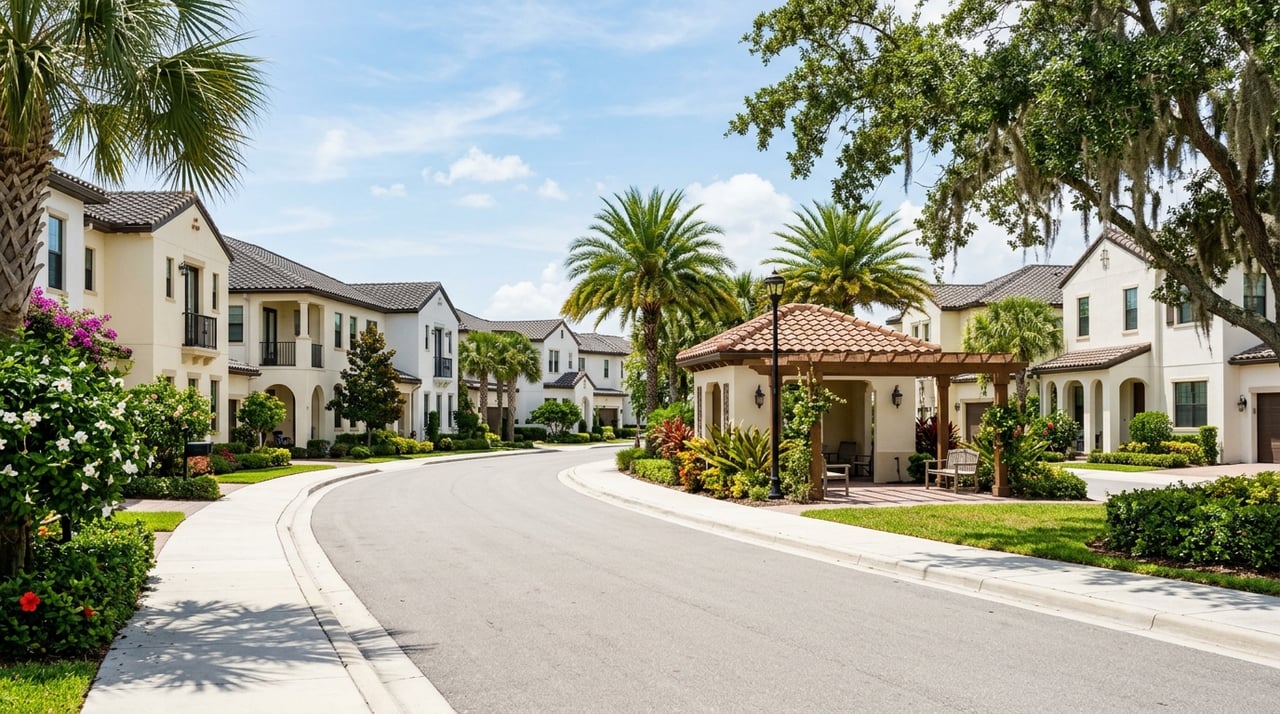
That matters because in Clay County, a master-planned community often feels more like a small district than a standalone neighborhood. You may see residential sections, amenity centers, green space, and sometimes commercial areas all working together inside one larger plan.
Where you see it locally
Several well-known Clay County communities show how this concept works in real life. Each one has its own character, but they share the same big idea: planned growth with multiple neighborhood components and shared amenities.
OakLeaf Plantation
OakLeaf Plantation is one of the clearest local examples. Its official materials describe it as a 6,400-acre community with village centers, athletic centers, a golf course, school sites, commercial and office space, and preservation land.
Amenities include waterparks, fitness facilities, sports fields, tennis and basketball courts, clubhouses, and playgrounds. That kind of setup gives you a sense of what buyers often expect from a large master-planned community in Clay County.
Fleming Island Plantation
Fleming Island Plantation is a more established planned community. The community opened in 2000 and includes more than 2,400 homes across 17 communities, along with amenity facilities, pools, parks, playgrounds, sports courts, golf, and Village Square shops and restaurants.
It is also a deed-restricted CDD, which is important for buyers to understand. Exterior changes require BAR approval, so ownership comes with more structure than you might find in a neighborhood without similar oversight.
Eagle Harbor
Eagle Harbor is another mature example in Fleming Island. Its community features include a waterpark, tennis, pickleball, docks, and a broad amenity system used by residents.
It also shows how governance can become layered in a planned community. Eagle Harbor includes multiple master HOAs and sub-associations, each with its own board and budget.
Branan Field and Lake Asbury
Branan Field and Lake Asbury are not single communities. They are county master-plan areas where development follows larger land-use and infrastructure goals.
These areas matter because they are among the county’s faster-growing corridors, shaped in part by the First Coast Expressway. If you are looking at newer neighborhoods in Clay County, there is a good chance your search will overlap with one of these larger planning areas.
What you can expect inside these communities
Master-planned communities in Clay County usually offer more than homes alone. Many combine residential phases with recreation, civic uses, and sometimes shopping or office space.
That mix is a major reason buyers are drawn to them. Instead of looking at a neighborhood as just a place to sleep, you may be looking at a community designed around day-to-day routines.
Common amenities
Amenities vary by community, but common features include:
- Pools or waterparks
- Clubhouses
- Fitness centers
- Tennis and pickleball courts
- Basketball and volleyball courts
- Golf features
- Parks and playgrounds
- Docks and trails
- Retail or restaurant areas in some developments
The key question is not whether those amenities sound nice. It is whether you will actually use them enough to justify the cost and rules that often come with them.
Home styles and housing mix
Clay County master-planned communities often include a mix of housing types. Depending on the development, you may find single-family homes, townhomes, multifamily components, or apartments within the same overall plan.
That can be helpful if you want options within one area. It can also mean that two homes in the same larger development may feel very different depending on the section, association structure, and amenity access.
The biggest tradeoff: convenience vs. flexibility
For many buyers, the real decision comes down to predictability versus freedom. Master-planned communities often offer a more consistent look, organized upkeep, and easier access to shared amenities.
At the same time, they usually come with more rules. You may need approval for exterior updates, face guest-use policies at amenities, or deal with multiple layers of governance depending on the community.
That tradeoff is not automatically good or bad. It simply means you should match the community structure to the way you actually want to live.
HOA, CDD, and approval rules explained
Before you buy in a Clay County master-planned community, it helps to understand the basic ownership mechanics. These communities often involve more than one fee and more than one governing body.
How HOA rules affect ownership
In Florida, mandatory HOAs are governed by Chapter 720. The law requires associations to be Florida corporations, maintain official records, provide access to records after a written request, hold open board meetings with limited exceptions, and prepare annual budgets that separately identify recreation amenity costs.
For you as a buyer, the practical takeaway is simple. Community rules, annual budgets, reserve funding, and special assessments are not side issues. They are part of the ownership experience.
What a CDD means
Some master-planned communities in Clay County also include a CDD, or community development district. Under Florida Chapter 190, a CDD is a special-purpose local government entity that can authorize certain taxes, assessments, public improvements, and community facilities.
In everyday terms, that can mean your carrying costs include both HOA-related obligations and CDD-related assessments. If you are comparing one community to another, this is a major area to review carefully.
Exterior approvals and restrictions
Many planned communities require approval before you make certain exterior changes. In local examples, Eagle Harbor has layered association oversight, while Fleming Island Plantation requires BAR approval for exterior modifications.
That does not mean the rules are unreasonable. It means you should know them before you buy, especially if you already have plans for fencing, paint colors, landscaping, roof changes, or other visible updates.
Costs buyers should plan for
When you budget for a master-planned community, do not stop at principal, interest, taxes, and insurance. Your true monthly and long-term cost may include several additional items.
These can include:
- HOA dues
- Amenity-related fees
- Reserve contributions
- Possible special assessments
- CDD assessments, where applicable
If you are considering new construction, local fee structure matters too. Clay County says complete building permit applications submitted on or after June 1, 2024 are subject to county comprehensive impact fees, mobility fees, and school impact fees as applicable. The county also states that mobility fees are collected for new development to help fund road improvements tied to growth.
Those costs may not always show up the same way from one builder or community to another, but they are part of the broader pricing picture in newer planned areas.
How to decide if it fits your lifestyle
A master-planned community can be a great fit if you want shared amenities, a more organized neighborhood layout, and a clear structure around maintenance and appearance. In Clay County, that often appeals to buyers who want convenience and a neighborhood designed around daily routines.
Other buyers may prefer a traditional neighborhood with fewer layers of governance. Others may lean toward rural property for more land and fewer common obligations.
The right choice depends on what you value most.
A smart Clay County checklist
As you compare communities, focus on these questions:
- What is the total monthly cost, including HOA dues, CDD assessments, and any other recurring fees?
- What approval rules apply to exterior changes, rentals, and everyday property use?
- Which amenities will you really use?
- How does the location fit your commute and access to parks, shopping, and other daily destinations?
- Are you more comfortable with a mature resale home or a newer build that may come with ongoing construction or changing fee structures?
If you answer those questions honestly, the decision usually becomes clearer.
Why local guidance matters
On paper, two Clay County master-planned communities can look similar. In practice, they may have very different fee structures, approval processes, amenity access, and resale patterns.
That is where local experience can save you time and stress. If you are relocating, buying remotely, or trying to compare resale versus new construction, it helps to have someone who knows the differences between Fleming Island, OakLeaf-area options, Lake Asbury growth patterns, and other Clay County neighborhoods.
If you want help sorting through Clay County communities and finding the right fit for your budget, lifestyle, and timeline, schedule your free neighborhood consultation with Leslie Smith.
FAQs
What is a master-planned community in Clay County, FL?
- In Clay County, a master-planned community is typically part of a larger growth plan that combines housing with infrastructure, amenities, and sometimes civic or commercial uses, rather than being just a single subdivision.
What amenities do Clay County master-planned communities usually offer?
- Many offer features like pools, waterparks, clubhouses, fitness centers, sports courts, parks, playgrounds, docks, trails, golf features, and sometimes nearby retail or dining areas.
What is the difference between an HOA and a CDD in a Clay County community?
- An HOA manages community rules, budgets, and shared property, while a CDD is a special-purpose local government entity that may levy assessments or taxes for infrastructure and community facilities.
Do Clay County master-planned communities have rules for home changes?
- Yes, many do. Depending on the community, exterior changes may require approval through an architectural review process such as an ARC or BAR.
Are master-planned communities in Clay County only for new homes?
- No. Clay County includes both established master-planned communities with resale homes and newer planned areas where buyers may find new construction.
How do I know if a Clay County master-planned community is right for me?
- Compare total monthly cost, community rules, amenity value, commute patterns, and whether you prefer the structure of a planned community over the flexibility of a traditional neighborhood or rural property.